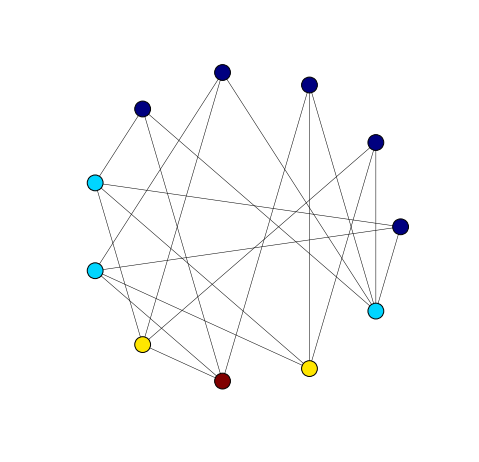
Computationally, though, the chromatic polynomial is an expensive object to
construct. However, we can still use this method to calculate the chromatic
numbers of small graphs.
In this blog we try to find more than one method for every calculation and for
every method we try to give more than one implementation. This is because,
ultimately, we hope to have reliable, reproducible results. As far as
reliability goes, redundancy in our data is important and so, for this
reason, here we provide another implementation of the chromatic number based
on the chromatic polynomial.
In the previous post we used exclusively NetworkX for the implementation. Here
we use traditional GNU utilities like Sed, cat, tr and tail, the Graphviz
program gvpr, the GNU Maxima computer algebra system and an implementation
of the Tutte polynomial by Haggard, Pearce and Royle.
Chromatic Numbers of Small DOT Graphs
Our program, which is little more than a wrapper script, takes as input a
graph in DOT format and outputs the chromatic number. The program works by
following the four steps below.
compute the maximum degree of the input graph,
convert the Graphviz data file into the input graph format used by the
tutte program,
compute the chromatic polynomial using tutte,
compute the chromatic number using GNU Maxima.
The only non-trivial work here is done by the tutte and Maxima programs.
Our script is simply a driver or wrapper providing a convenient interface.
In fact, the dependency on GNU Maxima here could doubtless be removed because
tutte is able to compute values of the polynomials it computes.
In a forthcoming post we will use the program described in this post to
reproduce, and hopefully extend, the data from last week’s post on chromatic
numbers of small graphs. In the rest of this post we describe each of the
four steps above in detail.
Maximum Degree Computation
Some graph data formats include parameter data like number of vertices and
number of edges. In this context we assume that we have a graph in DOT format
without any additional parameter data. As it turns out, the tutte program
infers the parameter data it needs from the graph input. So we are only left
with need to calculate the maximum degree which is needed outside of tutte
as the upper limit of the main loop.
A gvpr program, maxdeg computes the maximum and minimum degree
of graphs in DOT format.
$ curl -s https://raw.githubusercontent.com/MHenderson/graphs-collection/master/src/Classic/Chvatal/chvatal.gv\
  | gvpr -f maxdeg
max degree = 4, node 0, min degree = 4, node 0
To use this program in our final pipeline we simply scrape out the maximum
degree value from this output using Sed:
$ ...
  | sed -n 's/max degree = \([0-9]*\).*/\1/p'
4
Convert Graph Format
The input format for tutte is quite similar to the DOT format that we are
using as the input format for our program. In the tutte format, edges are
designated by a string of the form x--y and a graph is a comma separated
list of edges.
To convert a graph in DOT format into the tutte input format can thus be
accomplished by:
matching edges of the form x -- y; and replacing them with edges of the
form x--y,,
removing all whitespace, including newlines,
removing the final, extraneous comma.
A pipeline involving Sed and tr is by no means the only way to accomplish
this sequence of replacements but suffices for our purposes.
$ curl -s https://raw.githubusercontent.com/MHenderson/graphs-collection/master/src/Classic/Chvatal/chvatal.gv\
  | sed -n 's/\([0-9]*\) -- \([0-9]*\);/\1--\2,/p'\
  | tr -d ' \t\n\r\f'\
  | sed '$s/.$//'
0--1,0--4,0--6,0--9,1--2,1--5,1--7,2--3,2--6,2--8,3--4,3--7,3--9,4--5,4--8,5--10,5--11,6--10,6--11,7--8,7--11,8--10,9--10,9--11
Compute the Chromatic Polynomial
There is almost nothing to this step. We simply call the tutte program on the
data from the previous step and scrape the output for the polynomial string
result.
The important options for tutte in this context are --stdin which tells
tutte to expect input from standard input and --chromatic which asks for
the chromatic, as opposed to Tutte, polynomial.
Now that we have a string representation of the chromatic polynomial we
compute the chromatic number as the least positive integer for which the
represented polynomial has a positive value. As
for all graphs , this can require the computation of most
values of the chromatic polynomial.
To compute a value of the chromatic polynomial from the string representation
output by tutte we use the GNU Maxima computer algebra software. The at
command of Maxima returns the value of its first argument polynomial string
at the value of variables given in the second argument. For example, if cp
is the string from the previous step then at(cp, x = 0) is the value of the
polynomial represented by cp at x = 0.
m: ${max_degree}$
cp: ${cp}$
chi: for i: 1 thru m + 1 do
       if at(cp, x = i) > 0 then return (i)$
print(chi);
Maxima is an interactive program but can also be used non-interactively through
the --batch or --batch-string options. The latter is sufficient for us,
because our Maxima program is very short.
s="
m: ${max_degree}$
cp: ${cp}$
chi: for i: 1 thru m + 1 do
       if at(cp, x = i) > 0 then return (i)$
print(chi);"

maxima --batch-string="$s"
The default output of Maxima includes a license header and all input and
output, including labels. The header can be switched off using the
--very-quiet option. This option also removes the labels from input and
output text. So now to scrape out the chromatic number itself we use tail
to restrict our view of the output to the last line. The chromatic number
is centred on this line so we remove whitespace using tr.
Until now we have considered two different simple methods for colouring
vertices of graphs. Greedy colouring and recursive removal of independent
subgraphs. Neither of which guarantee a colouring with the minimum number of
colours under the most general conditions.
In the last few posts we did some simple experimentation to compare the total
of chromatic numbers over all graphs on at most seven vertices against the
total colours used by our greedy and recursive independent set extraction
methods. This experimentation turned up some unexpected numbers and so it
became necessary to investigate the data we have been using more closely so
as to rule out corrupt data as a reason for the discrepancy.
We observed two things from these small experiments. Firstly, we observed that
both methods used more colours than the minimum. We also observed that our
NetworkX-based implementation of the greedy method appears to use many more
colours than Joseph Culberson’s C version. For this reason we started to think
about ways in which we could verify the data used.
As we know the distribution of chromatic numbers over small graphs, one method
to verify the graph data we are using is to try to reproduce this chromatic
distribution data.
In this post we therefore present an implementation of the chromatic number
based on the chromatic polynomial. In upcoming posts we will return to the
verification of experimental data collected in previous posts.
The Chromatic Polynomial
The chromatic polynomial is the number of
-colourings of . The chromatic polynomial is, as the name
suggests, a polynomial function. To compute values of the chromatic polynomial,
which can then be used to calculate the chromatic number, we will exploit the
fact that it is a special case of the Tutte polynomial
.
Theorem
The Tutte polynomial has been implemented by
(Björklund, Husfeldt, Kaski, & Koivisto, 2008) in the
tutte_bhkk module for NetworkX.
Having an implementation of the Tutte polynomial, by the above Theorem, makes
our job of implementing the chromatic polynomial a near triviality.
In the tutte_bhkk module there is a function tutte_poly which returns a
nested list of coefficients of the Tutte polynomial. Our implementation of the
chromatic polynomial will create a polynomial object rather than a coefficient
list. So first we create a function that translates the tutte_bhkk
coefficient list into a sympy polynomial. This is done by building a
string representation of the Tutte polynomial of a graph and then using the
ability of sympy.poly to construct a polynomial object from such a parameter
string.
With this function now we can find, for example, the Tutte polynomial of the
Petersen graph.
P=nx.petersen_graph()tutte_polynomial(P)
With the Tutte polynomial implemented as a sympy polynomial constructing the
chromatic polynomial of a graph is a no more than a simple expression. For
greater convenience we embody this expression in a function,
chromatic_polynomial.
Returning to the Petersen graph, the chromatic polynomial is:
cp=chromatic_polynomial(P)cp
Now to use the chromatic polynomial to find the chromatic number of a graph it
should be clear what we have to do. The Poly member function subs
allows us to compute values of the chromatic polynomial. As there are no
2-colourings of the Petersen graph we expect that cp.subs(l, 2) is zero,
which it is.
cp.subs(l,2)0
Then if we compute cp.subs(l, 3) we are not surprised to see a non-zero value
because we already knew that the chromatic number of the Petersen graph is 3.
cp.subs(l,3)120
We see that the chromatic number of the Petersen graph is 3 because that is
the least integral value of for which ,
when is the Petersen graph.
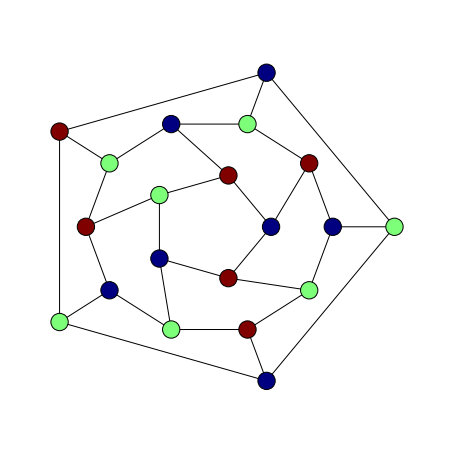
The same calculations for the Chvatal graph show that the chromatic number of
the Chvatal graph is 4:
In this section we return again to the set of all graphs on at most seven
vertices, albeit with more care than was given in previous posts. The first
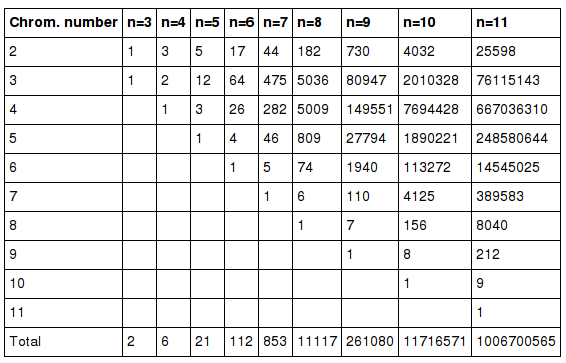
objective is to reproduce Gordon Royle’s table of chromatic numbers of small
graphs as far as graphs on seven vertices. In doing this we recognise one
reason for previously reported discrepant data. Royle’s table is a table of
chromatic numbers for connected graphs whereas our approximations to the sum
of all chromatic numbers were computed over the set of all graphs of order at
most seven.
Below, we construct two lists data and c_data. The data list is populated
with the chromatic number data for all graphs in the set graph_atlas_g() of
all graphs on at most seven vertices. The c_data list records the same data
but only for connected graphs.
Creating a table of the distribution of chromatic numbers over all connected
graphs of order at most seven we reproduce Royle’s data. The function
html_table (not shown here) is based on Caleb Madrigal’s post
Display List as Table in IPython Notebook.
So this gives us some confidence in the NetworkX data as well as the above
method for computing chromatic numbers.
References
Björklund, A., Husfeldt, T., Kaski, P., & Koivisto, M. (2008). Computing the Tutte Polynomial in Vertex-Exponential Time. In Proceedings of the 2008 49th Annual IEEE Symposium on Foundations of Computer Science (pp. 677–686). Washington, DC, USA: IEEE Computer Society. https://doi.org/10.1109/FOCS.2008.40
The previous two posts were about greedy colouring small graphs. In the
first post an implementation of the greedy algorithm in Python with NetworkX
was used to colour all graphs on at most 7 vertices. We compared different
vertex orderings by counting, for different ordering strategies, the total
number of colours used on this set of graphs. In the subsequent post we
repeated this experiment and extended it to graphs on at most 8 vertices
using Culberson’s colouring programs.
Perhaps surprisingly, Culberson’s programs did much better than our Python
implementation. The most likely explanation is simply that our greedy colouring
Python code is broken. Before we can conclude this, though, it is probably a
good idea to investigate colouring the same set of graphs using another vertex
colouring algorithm.
The goal of this post then is to introduce a slightly different approach
to graph colouring, the method of recursive
independent set removal.
Chromatic Numbers of Small Graphs
The minimal total number of colours used in a proper colouring of all graphs
on at most seven vertices is 3348, computed from the following table which is
found on Gordon Royle’s Small Graphs data page:
The total number of colours used by Culberson’s greedy program with
descending degree vertex ordering was 3616. The total number of colours used
by the NetworkX-based implementation was 4120.
These values differ by 504, which seems quite a large discrepancy as a
proportion of the minimum of 3348 colours. What could be the cause? Or is
this not a significant discrepancy? It seems to me that there are
a few possibilities. The most likely explanations are problems with the
data sets used in the experiments or a flaw in our implementation of
the greedy algorithm. These possibilities should be eliminated first before
embarking on a larger study to decide whether the discrepancy is significant
or not.
Whatever are the reasons for the discrepancy it seems that some testing and
verification of both graph data and colourings is in order. Seeing as we have
been avoiding this issue in earlier posts it seems like an appropriate time
to improve the reliability of our data.
To this end, it would be useful to have still more than implementations of
vertex colouring. In this post we implement another vertex colouring algorithm
based on the idea of recursively extracting a large independent set.
Colouring by Stable Set Recursion
The implementation in NetworkX of recursive maximal independent set extraction
is very simple because NetworkX implements the algorithm from
(Boppana & Halldórsson, 1992) in the function maximal_independent_set. Notice that
this is a maximal independent set algorithm, not a maximum independent set
algorithm. So at each level of recursion, we find an approximation to a
maximum independent set. With small graphs this approach seems reasonably
successful.
fromcopyimportdeepcopydef__vcolour3__(G,C,level=0):"""Vertex colouring by recursive maximal independent
set extraction."""H=deepcopy(G)if(H.number_of_nodes()>0):V1=nx.maximal_independent_set(H)forvinV1:C[v]['colour']=levelH.remove_nodes_from(V1)__vcolour3__(H,C,level+1)defvcolour2(G):"""Interface for vertex colouring by recursive maximal
independent set extraction."""return__vcolour3__(G,G.node)
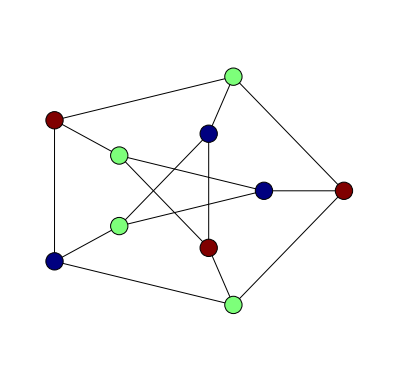
With the Petersen graph, for example, we find a minimal colouring with three
colours:
This value is closer to the larger value of total colours used by our NetworkX
based implementation of greedy vertex colouring. In upcoming posts we will
return to the question of testing graph data so that we can rule out problems
with the graph data used in these experiments.
References
Boppana, R., & Halldórsson, M. M. (1992). Approximating maximum independent sets by excluding subgraphs. BIT Numerical Mathematics, 32(2), 180–196. https://doi.org/10.1007/BF01994876
In the previous post we conducted a small experiment to compare the total
number of colours used by the greedy vertex colouring algorithm on a collection
of small graphs. The aim of that experiment was to see whether, over a large
number of graphs, the total number of colours used by different degree
orderings was significant. The tool we used was NetworkX. In this post we
revisit this experiment with Culberson’s colouring programs.
As Culberson’s implementation of the greedy colouring algorithm works with
graphs in Dimacs format we need to first generate a collection of small graphs
in that format. Fortunately, on the homepage of Brendan McKay
there is a large collection of combinatorial data, including
small graphs up to order 10. These graphs are in graph6
format but translating a graph from graph6 to Dimacs format is not too
difficult thanks to some tools written by McKay for working with graphs in
graph6 format.
So this is what we are going to do:
Download small graphs in graph6 format from BDM’s combinatorial data pages.
Convert all graphs from graph6 to Dimacs
Split file of Dimacs graphs into files, each containing one graph.
Colour graphs with ccli using different vertex orderings
Compute total colouring numbers per ordering
Convert from graph6 to Dimacs
The graph6 format is a format devised by Brendan McKay for the
nauty(McKay & Piperno, 2014) graph isomorphism software. In this post we
won’t attempt to describe how this format is defined. For further information
see the
graph6 and sparse6 graph formats page
on McKay’s homepage. Gordon Royle also has some useful information about
graph6 and sparse6 formats on his homepage.
The program listg (and its companion showg) which belongs to the nauty
project can display graph6 graphs in various human readable formats. One format
which is easy to convert into other formats is the edge format.
So in graph2.g6 there are two graphs. The first graph has 2 nodes and 0 edges.
The second graph has 2 nodes and 1 edge. The edge joins vertices 0 and 1.
To convert one of these files into a file of graphs in Dimacs format we use
a combination of Sed and AWK. A Sed one-liner can convert a list of edges of
the form x y into the x -- y form used in Dimacs. AWK will enable us to
process the file of graphs in the above edge-list format and apply to Sed
one-liner to each graph. The Sed one-liner in question is:
sed -r -e 's/([0-9]+) ([0-9]+)/ e \1 \2\n/g' $1
Now if we think of one of BDMs files as being made of records, each of
which is a graph and consists of three lines, the third of which is the list
of edges then we can use AWK to convert this into a file of DOT format graphs
like so:
awk -f e2dimacs.awk output.txt > result.txt
where e2dimacs.awk is the following little snippet:
and the e2dimacs command is the above Sed one-liner.
Putting everything together into one pipeline:
$ curl -s http://cs.anu.edu.au/~bdm/data/graph2.g6\
  | listg -e\
  | awk -f e2dimacs.awk

p edge 2 0

p edge 2 1
 e 0 1
Split into individual files
Unfortunately, greedy expects that an input file contains a single graph to
be coloured. This means that if we want to colour a collection of graphs in one
file we have to split that file into many. One of the easiest methods is to use
AWK.
Suppose we had redirected the output from the last command of the previous
section into a file graph2.g6 then the following command
Creates two files 0.dimacs and 1.dimacs, containing the first and second
graph from the original graph6 file but now converted in Dimacs format.
Colour with greedy
At this point we have a collection of graphs each in a file of its own. We
want to iterate all such files and run greedy with a specific ordering. This
is easy if we know how many graphs are contained in the collection. We can
just create a loop of the write length in Bash and at each step of the loop
we call ccli with the correct parameters and the filename based on a loop
index.
for n in {0..10};\
do\
  ccli greedy --type=simple --ordering=inorder $n.dimacs;\
done
Compute colouring numbers
The output of calling greedy on a file n.dimacs is a file n.dimacs.res
in the same folder as the first file and containing the colouring data. The
line preceding the colouring itself also contains the number of colours used
and we can extract this number using another Sed one-liner:
sed -n 's/CLRS \([0-9]*\) [A-Z a-z = 0-9 .]*/\1/p' *.dimacs.res
The file argument here expands to a list of all files with the suffix
.dimacs.res. The output is then a list of numbers, each a number of colours
used in a certain colouring. We want to total all of these numbers. There
are several different ways of summing numbers in a file. One convenient approach
combines the paste and bc commands. The following pipeline will find all
colouring numbers for a collection of files and return the total number of
colours used.
sed -n 's/CLRS \([0-9]*\) [A-Z a-z = 0-9 .]*/\1/p' *.dimacs.res\
| paste -s -d"+"\
| bc
Experiment Results
We put all of the steps together into a simulation. This simulation went through
all graphs of order at most 8 and computed the total number of colours used by
the greedy algorithm using four different orderings. The results are given in
the table below.
ordering
order
order
in order
3732
42603
random order
3906
44770
descending degree
3616
41102
ascending degree
3965
42181
As before we can see that descending degree is the best way to go, at least for
graphs of order at most 8.
In the previous post we showed that a greedy vertex colouring of a graph
uses at most colours. This sounds good until we realise that
graphs can have chromatic number much lower than the maximum degree.
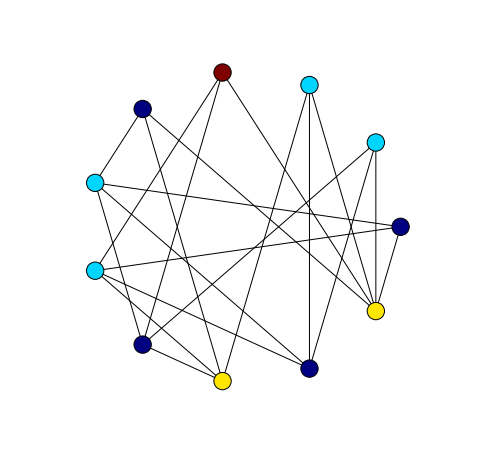
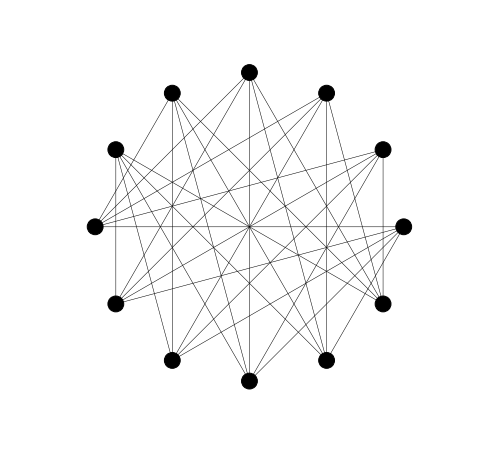
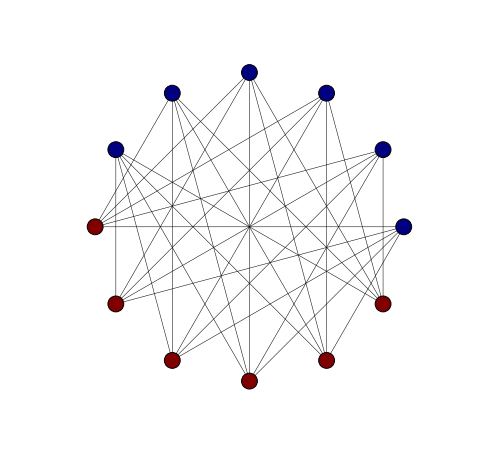
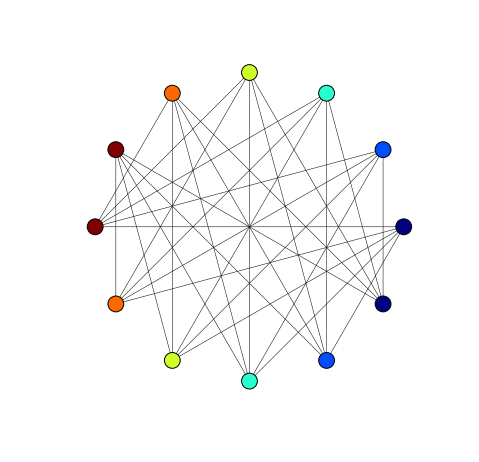
The crown graphs, sometimes called Johnson graphs are complete bipartite
graph with a one-factor removed.
importnetworkxasnxdefone_factor(n):"""The one-factor we remove from K_{2n,2n} to make a crown graph."""returnzip(range(n),range(2*n-1,n-1,-1))defcrown_graph(n):"""K_{n, n} minus one-factor."""G=nx.complete_bipartite_graph(n,n)G.remove_edges_from(one_factor(n))returnG
However, the maximum degree of a crown graph of order is and,
with some vertex orderings, a greedy colouring of uses
colours.
importitertoolsdefbad_order(n):"""Visit nodes in the order of the missing one-factor."""returnitertools.chain.from_iterable(one_factor(n))clear_colouring(G)vcolour(G,nodes=bad_order(6))nx.draw_circular(G,node_color=colours(G),**options)
We might ask, what vertex orderings lead to colourings with fewer colours? The
following theorem of Dominic A. Welsh and Martin B. Powell is pertinent.
Theorem (Welsh, Powell)
Let be a graph of order whose vertices are listed in the order so that
.
Then
In the case of regular graphs, like the crown graphs, this theorem reduces to
the upper-bound on the chromatic number. For graphs that are not
regular this result suggests that we can get a tighter bound on the chromatic
number by considering orderings of vertices in non-increasing degree order.
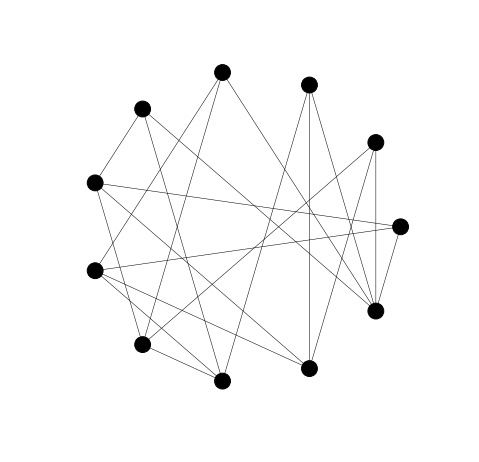
The Grotzsch graph is an irregular graph that plays an important role in the
study of graph colouring. Unfortunately, it is not one of the named graphs in
NetworkX. We can, however, download it from the
House of Graphs as a file in graph6 format. Then we can use the
read_graph6 function to read it into a NetworkX graph.
We can compute the bound from the Welsh-Powell theorem.
defwelsh_powell_number(G,nodes=None):"""Calculate bound from Welsh-Powell theorem with nodes in given order."""ifnodes==None:nodes=G.nodes()iflen(nodes)==0:return0else:return1+min([max(i,G.degree(nodes[i]))foriinrange(len(nodes))])welsh_powell_number(G)4
which is a significant improvement over the bound. In fact,
the chromatic number of the Grotzsch graph is 4 and a greedy colouring with 4
colours can be found.
We might suspect then that a good vertex colouring strategy is greedy colouring
with vertices in non-increasing degree order. In the next section we devise a
small test of this claim.
Greedy Strategies for Colouring Small Graphs
NetworkX comes with a collection of all unlabelled,
undirected graphs on seven or fewer vertices based on
(Read & Wilson, 2005). The experiment below colours every graph in
this collection using four different vertex orderings: in order, random order,
decreasing degree order and increasing degree. In order is the order ordering
of vertices in the data representation of the graph. In the case of NetworkX
this just means that we colour vertices in the order they appear in
G.nodes(). Random order just means that we first shuffle this list using
random.shuffle. The other orderings are defined by the degree_order
function below.
defdegree_order(G,reverse=False):"""Vertices of G, ordered by degree."""returnsorted(G.nodes(),key=G.degree,reverse=reverse)
In the following code extract we iterate over the graphs in graphs_atlas_g()
colouring each graph with each of the four above mentioned vertex ordering
strategies. We calculate the number of colours used by each colouring and, at
the end, we print out the totals of these numbers over all graphs.
We can see that the best ordering to use in this case is the ordering claimed in
Welsh and Powell’s theorem. Ordering vertices by their degree from highest to
lowest. The worst case is the reverse ordering and randomised and natural
orderings lie somewhere in between.
References
Read, R. C., & Wilson, R. J. (2005). An Atlas of Graphs (Mathematics). Oxford University Press.